« Zero Trust is not a destination. It is the only sustainable posture in an era where the speed of discovery has permanently outpaced the speed of patching. »
The speed of cyberattack has always outpaced the speed of defence. But in 2025, that gap widened permanently. AI-powered vulnerability discovery tools, now accessible to threat actors at low cost, can identify and exploit weaknesses in hours rather than weeks. Legacy perimeter-based security models were not designed for this reality. Zero Trust Architecture (ZTA) is no longer a best practice. It is the baseline.
What Zero Trust Actually Means
Zero Trust operates on a single principle: never trust, always verify. No user, device, or system is implicitly trusted regardless of whether it sits inside or outside the corporate perimeter. Every access request is authenticated, authorised, and continuously validated across seven distinct pillars.
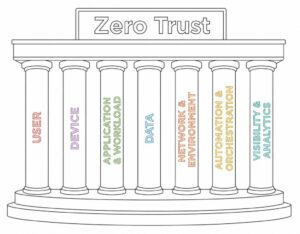
Figure 1 – Zero Trust 7 Pillars
The seven pillars: User, Devices, Networks, Applications, Data, Automation and Orchestration, and Visibility and Analytics, must each be assessed independently. Organisations that treat Zero Trust as a single product to install consistently underestimate both the scope and the return.
Why AI Changes the Equation
Historically, the window between vulnerability disclosure and widespread exploitation was measured in weeks. AI has compressed that window to hours. Automated scanning tools can now enumerate attack surfaces, identify unpatched systems, and generate targeted exploit code faster than any human team can respond.
Tools with these capabilities have been documented in active use since late 2024. The window to act is narrow.
The Seven Pillars: Where to Start
- User — every user and service account must authenticate via multi-factor, scoped to minimum required privilege
- Devices — only compliant, managed devices should reach sensitive systems
- Networks — micro-segmentation limits lateral movement across the environment
- Applications — application-layer access controls replace network-layer trust
- Data — classification and encryption at rest and in transit, applied at the data layer
- Automation and Orchestration — security policies enforced by code, response actions triggered automatically
- Visibility and Analytics — continuous monitoring across all seven pillars
« Organisations typically achieve the fastest ROI by starting with Identity and Devices: these two pillars alone eliminate the majority of common attack paths. »
What TyrTeq Recommends
Organisations should assess legacy exposure, design Zero Trust architectures across all seven pillars, and build migration roadmaps aligned with regulatory requirements including the EU AI Act and NIS2.
- Conduct a ZTA readiness assessment across all seven pillars
- Prioritise critical and end-of-life systems for immediate compensating controls
- Treat data as your most valuable asset apply data-centric security policies regardless of where your modernisation journey stands
Zero Trust is not a product you buy. It is an architectural posture you build incrementally, pillar by pillar. TyrTeq is the partner that stays with you through every decision, every deployment, and every evolution.
To explore further ZT Principles and Deployment, contact us at info@tyrteq.com